
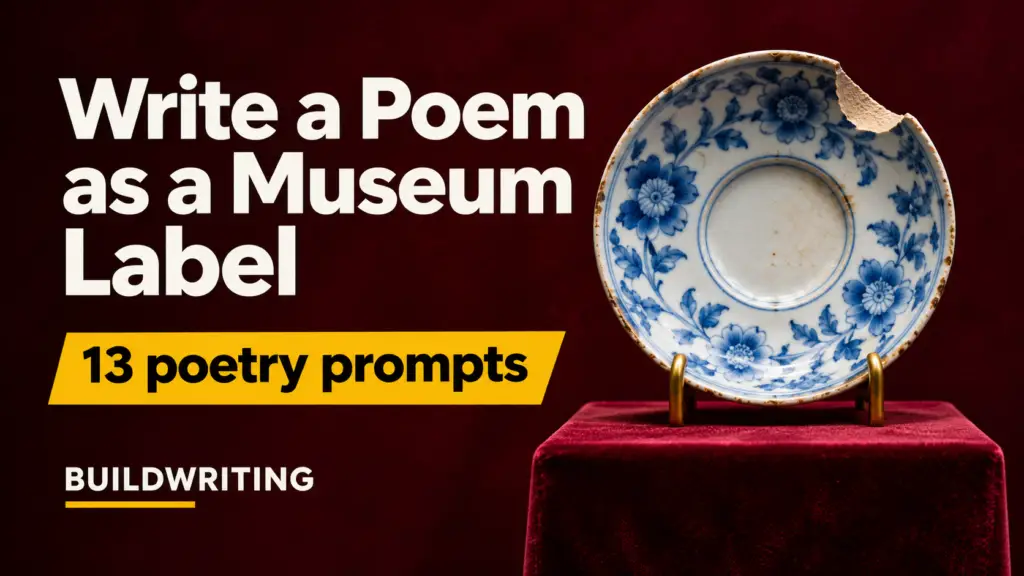
A museum label can tell you what you are looking at in a sentence. It can give you the date an object was made, describe an unusual repair, or name the person who gave it away. It leaves most of the object’s life to your imagination. A poem can begin in that space.
These 13 poetry prompts ask you to write about everyday objects as if they had been put on display. Give each item a few facts a stranger could check. Then find one thing a person who knew the object would notice that those facts leave open.
Try drafting in two passes. Write three lines in the museum’s voice. Then add three lines from somebody with a reason to pause in front of the case. Their reason can be as small as recognizing a mark their hand once made.
1. The spare key
A museum displays a key with no lock. The donor found it in the sleeve of a coat her brother had outgrown. She is sure it opened something inside the house because he used to check his pocket before he went upstairs.
Try it. Write a label that names the metal and describes the worn teeth. Give the donor one sentence to say what she used to hear from the landing. End with a detail that could belong to either the person who locked the door or the person who had to wait.
2. The cup with the unfinished handle
A pottery class left several pieces in the kiln room when the building closed. One cup has a handle that stops before it meets the rim. The person who made it comes to the exhibition and recognizes the cup by the mark their thumb left in the clay.
Try it. Try writing the physical description first in the museum’s voice and then in the maker’s voice. Put both accounts in a single poem. Give each person a different reason to be interested in the unfinished handle and let the reader see the gap.
3. A seat from the back of the bus
A bus seat goes on display after its route is canceled. The staff photograph the patterned fabric, the torn corner, and one armrest polished smooth. The donor wanted the seat because of a particular window it faced.
Try it. Give the armrest a sentence about daily use. Give the view from the missing window another sentence. Place the two together and see whether the visitor can imagine what somebody used to look for on the way home.
4. A measuring tape worn at the same mark
A dressmaker gives a museum a tape that has almost split at twenty-seven inches. The museum prepares a label about careful work. Her daughter recognizes the mark as the measurement her mother used to check every autumn before cutting a school skirt.
Try it. Write a label with two dates, the first measurement and the last. Allow one number to stay the same while something else changes. The skirt may belong to a different child at the end, or the daughter may be the one doing the measuring.
5. The alarm clock set seven minutes fast
A clock in a case reads a different time from the clock above the door. A visitor says the display is accurate. The owner kept the alarm seven minutes fast and still managed to miss the same appointment twice.
Try it. Give the written label an official time and let the poem supply the owner’s time. Show what could happen in the space between them. A kettle can boil, a person can decide to knock, or a bus can make it around the corner.
6. The borrowed umbrella
The museum calls the umbrella a gift. A woman who visits the display describes it as a loan and can point to the brass button her father put on the strap. She has brought a dry umbrella to offer in exchange.
Try it. Write a label that changes while we read it. Keep the first description visible and insert a short correction below. Then give the woman one line about when she expected the umbrella back. The weather can make the line sound practical or overdue.
7. One shoe from a dance hall
A soft shoe is displayed on a small stand. Its companion was repaired twice and is still being worn by the donor. The label has space for the year, the material, and one note about the floor where the shoes first moved together.
Try it. Write that last note so a person can feel their own weight move. You might describe the place where the boards dipped near the musicians or the edge of a groove where dancers turned. Finish on a movement the person could still make today.
8. The pencil somebody kept sharpening
A pencil in a glass case is too short to hold comfortably. It once belonged to somebody who took attendance in an evening class. The donor can remember how the teacher held it after two fingers stopped bending.
Try it. Describe the method of holding it before you mention the fingers. Add one name the teacher had to write carefully. Decide whether the person attached to that name would remember the pencil or only the sound of somebody saying they were present.
9. A photograph displayed face down
The museum displays the back of a photograph so visitors can read a brief note in blue ink. A visitor knows who stood on the other side of the paper and offers to describe where their hands were. The names in the note are spelled correctly.
Try it. Start the poem with a description of the paper, then add one detail only someone on the far side of the camera could know. Try keeping the photograph face down all the way to the end. See what kind of picture the words can make.
10. The repaired kitchen strainer
A strainer on display has a small wire patch over a hole. The repair is neat enough that most visitors think it came that way. The donor says the patch appeared the week the household began cooking for one more person.
Try it. Let the label state what the wire is made of and show exactly where it sits. Use the poem to supply a sound from that first week. The scrape of a bigger pot or another person pulling up a chair can give the repair a place in the household.
11. The welcome mat with no lettering
The date on a welcome mat is uncertain because the owner bought two identical mats years apart. The front of the second still says hello. On the first, the letters are gone and the fibers lean toward the door.
Try it. Write one sentence for a label that could fit either object. Then give the older mat a description that makes its years of use visible. End with a visitor who recognizes the worn one by a way they remember stepping around it.
12. A ribbon from the wrong event
The label says a red ribbon was awarded at a school sports day. The donor’s sister remembers it coming home tied to the handle of a lunch bag. She still owns the bag and can show the staff where the dye rubbed off.
Try it. Give the museum one believable reason to think its account is accurate. Then follow the sister’s eyes from the case to the faded mark. Write a final label she would agree to without requiring her to tell the staff the entire story of that afternoon.
13. An empty case with a fresh label
A display case contains a small wooden support and a card explaining what will be put back when the cleaning is done. A visitor came to see the object on the only afternoon they could get away. They know its dimensions from having carried it as a child.
Try it. Write a label that measures the missing thing. Let the visitor measure it a second time using their body, their coat pocket, or the distance between their hands. Choose one line that gives the absence a shape a reader can picture at the end.
Turn the label into a poem
Write the object’s name at the top of the page. Choose one measurable detail, such as a length, a date, or a number of stitches. Once a visitor can picture the object, let someone come close enough to notice what happens to the description when they look from another angle.
Here is one way to begin: “Kitchen stool. Pine. The front leg was shortened by half an inch.” The next line could give us the room where the change made sense: “At our house the floor rose toward the stove.” Even a short account of a repair can suggest a person who knew a room so well they changed a piece of furniture to suit it.
Read the label and the poem together. If both tell the same story, give the label a detail that becomes interesting only after the poem. Try ending on what someone does as they leave the case. A visitor can reach for a key they no longer have or step over an imagined groove in the floor. That movement lets the object return to ordinary life for a moment.